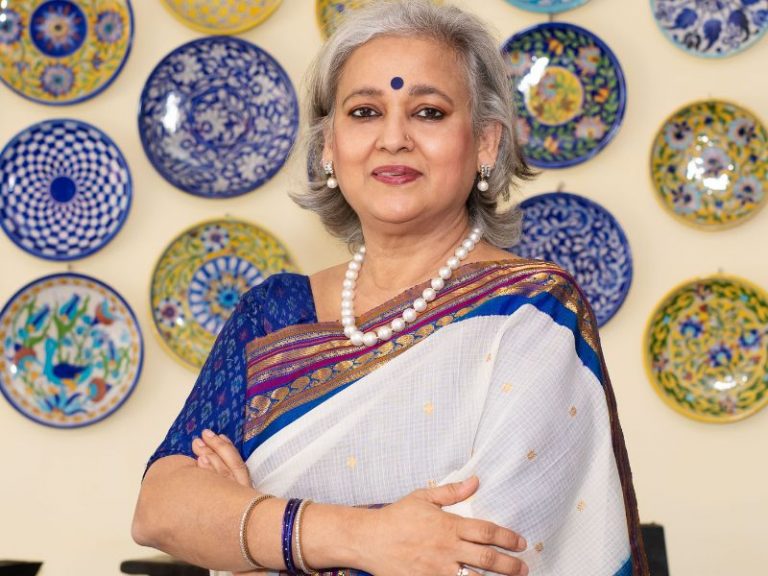
Aditi Misra has been the Founder Principal of DPS, Sector-45, Gurgaon since March 2002, and currently serves as its Director Principal. With previous roles as Headmistress at DPS Maruti Kunj and DPS Gurgaon, she brings extensive experience to her leadership positions.
Having earned an MEd from Annamalai University, Tamil Nadu, and a BEd degree from Indraprastha College, Aditi holds an MA in History from the University of Delhi. She is also an alumna of DPS schools at RK Puram.
Aditi’s contributions to education have been recognized through prestigious awards. In 2012, she received the first CV Raman Education Award for Excellence in Leadership and the Teachers Day Award for Recovering and Revitalizing Education for the COVID-19 Generation by the International Institute of Hotel Management. She was also honored with the Golden Door Award Singapore for Truth & Integrity of the Written Word as a Champion of Change.
“It must have seemed natural to me that the close-eyed obedience of the student was a form of bhakti. Bhakti was — this scene reminds us — a critique of the idea of god and bhakti itself. The andh bhakt worships the powerful, the academic-bhakt the powerless, so that both transform into a fetish. One wants to remain Hanuman, the other lives with the belief that it’s only a matter of time that they too will become Foucault. ‘Star professor’ should be an oxymoron in the classroom; but star professors lubricate the personality cult, seemingly unaware that it is a weapon of bullying and indoctrination. Instead of conquering the classroom like Alexander, I wish that teachers stood out of students’ sunlight.”
- Sumana Roy, The Indian Express, (7/9)
“University teachers are not government employees who can be transferred at the whims and wishes of the government. Universities are not government departments but autonomous institutions, governed by their own Acts. No Indian university figures in the list of top 100 universities of the world because our higher education is over-regulated and grossly underfunded. Let us reject the ‘control model’ of university governance and introduce the ‘liberty model’. There is a need to democratise the internal governance of universities, with students getting a say in all decisions. Our universities need to become student-centric instead of vice-chancellor-centric. Let faculty members get the freedom to speak and write so that knowledge creation can happen. Universities are established for intellectual progress, which demands maintaining the spirit of free inquiry. The pursuit and practice of truth, regardless of consequences, has been the cardinal motto of universities.”


















Add comment